LLM Application Development Services
LLM application development is the building of software powered by large language models - GPT-5, Claude, Llama - that read, write, reason, and act over your data. AutoNex Solution builds production LLM apps with RAG, vector search, tool use, and rigorous evaluation, so they're accurate and reliable, not demos. Shipped to your cloud in weeks, with full code ownership.
What goes into a production LLM application?
A production LLM application is far more than a prompt. It needs a retrieval layer (a vector database and RAG pipeline) so the model answers from your data with citations; tool use and function calling so it can take actions in your systems; an orchestration layer for multi-step reasoning; an evaluation harness to measure and improve accuracy; guardrails for safety and cost; and observability in production. We build the whole stack - and because we abstract the model behind a clean interface, you can switch between GPT-5, Claude, and open-source models without rewriting your app.
What we build with LLMs
Apps that turn a language model into real software.
Document intelligence
Q&A, search, summarisation, and extraction over your documents, contracts, and knowledge bases - with citations.
Copilots & assistants
In-product copilots that draft, analyse, and act inside your dashboard or app, grounded in the user's context.
Structured automation
LLMs that classify, route, and transform data inside workflows - turning unstructured input into clean, structured output.
How we build LLM applications
Engineering, not prompt-and-pray - measured at every step.
Scope & data
Define the task and the accuracy bar, and map the data the model will retrieve and act on.
RAG & retrieval
Build the vector store and retrieval pipeline - chunking, embeddings, and re-ranking tuned for accuracy.
Tools & orchestration
Add function calling, tool use, and multi-step orchestration so the app reasons and acts.
Evaluate & deploy
Measure accuracy with an evaluation harness, then ship to your cloud with monitoring.
Scope & data
Define the task and the accuracy bar, and map the data the model will retrieve and act on.
RAG & retrieval
Build the vector store and retrieval pipeline - chunking, embeddings, and re-ranking tuned for accuracy.
Tools & orchestration
Add function calling, tool use, and multi-step orchestration so the app reasons and acts.
Evaluate & deploy
Measure accuracy with an evaluation harness, then ship to your cloud with monitoring.
The LLM stack we build on
Everything, delivered and owned by you.
No lock-in, no hostage code. On delivery you get the full source, deployed in your cloud, with a 30-day post-launch window of free iteration.
Start your project- Production LLM application in your cloud
- Vector database + RAG retrieval pipeline
- Tool use & function calling integrations
- Evaluation harness with accuracy metrics
- Guardrails, cost controls & observability
- Model-agnostic architecture - no lock-in
Related work we've shipped
SastaGPT
From-scratch Transformer implementation for large language modeling.

Outlook-ChatGPT Automation
An intelligent email automation pipeline integrating Outlook with ChatGPT.
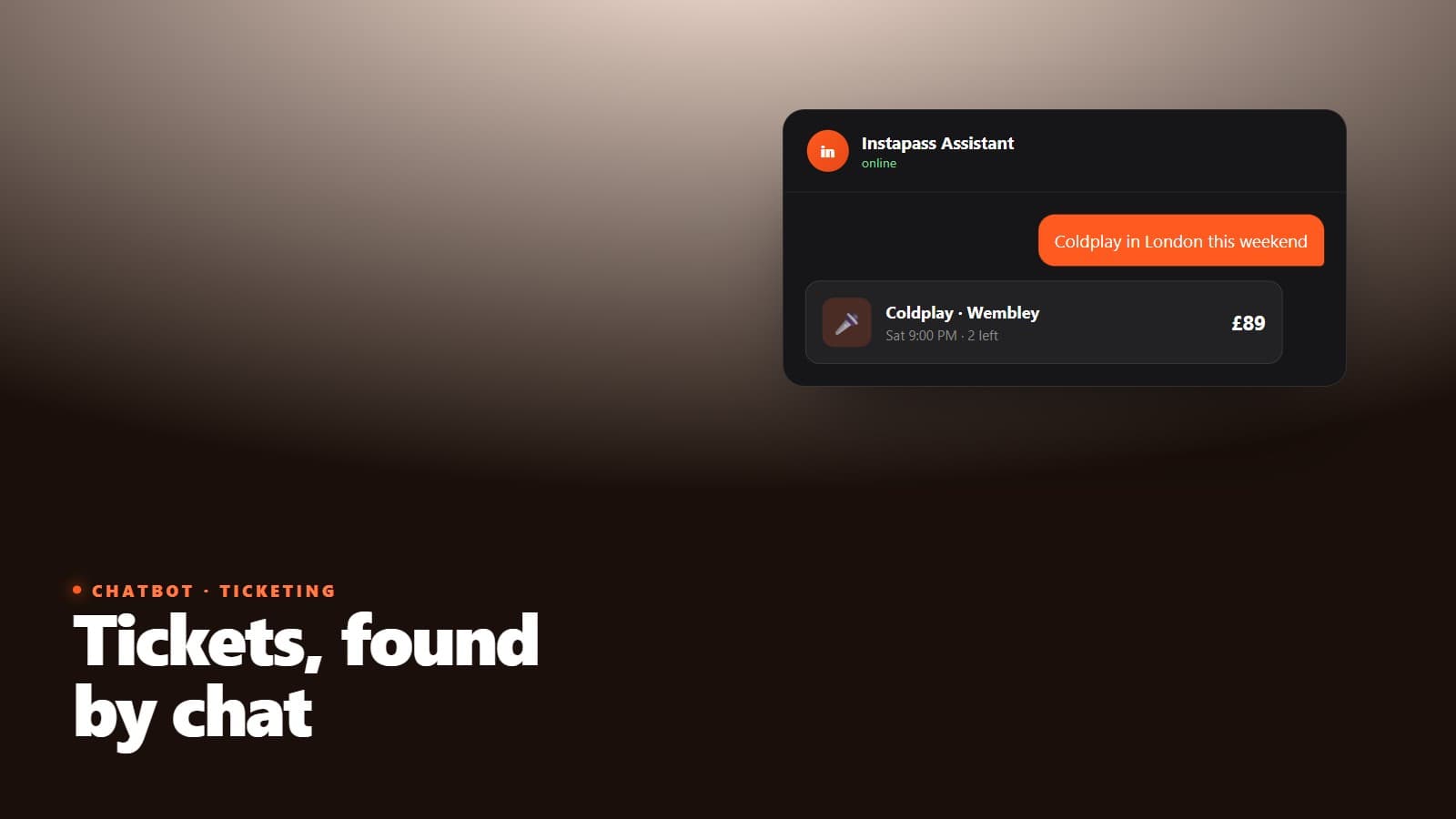
Instapass Chatbot
An intelligent chatbot for ticketing platform with affiliate integration.
LLM Application Development FAQs
Retrieval-augmented generation (RAG) retrieves relevant snippets from your data and feeds them to the model at answer time, so responses are grounded in your truth and can cite sources - instead of the model guessing from its training. It's the single most important technique for making an LLM app accurate, and it's in almost everything we build.